

Supervisor - data buffering
Mix.install([{:kino, "~> 0.9.4"}])Introduction
Practicing supervision, reading the book https://elixirpatterns.dev
what data buffering supervision tree is
- consumes data asynchronously from other processes
- summarizes that data
- flushes that data at a regular interval
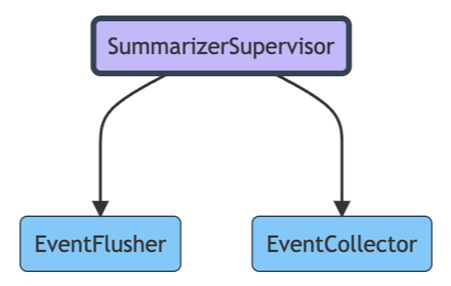
three components
EventCollector- aggregates asynchronous cast messages from other processes
EventFlusher- flushes the buffered data from
EventCollector
- flushes the buffered data from
SummarizerSupervisor- monitors these two processes
:one_for_onestrategy because there is no interdependence between child processes
Define modules
defmodule User do
  # these keys are required when creating a new struct
  @enforce_keys [:id, :name, :plan]
  defstruct [:id, :name, :plan]
end
defmodule EventCollector do
use GenServer
require Logger
## Client API
def start_link(options) do
GenServer.start_link(__MODULE__, options, name: __MODULE__)
end
def record_event(%User{} = user) do
GenServer.cast(__MODULE__, {:record_event, user})
end
def flush_events do
GenServer.call(__MODULE__, :flush_events)
end
## Server callbacks
@initial_state %{count: 0, data: %{}}
@impl true
def init(_) do
{:ok, @initial_state}
end
# Records an event
@impl true
def handle_cast({:record_event, %User{} = user}, state) do
new_count = state.count + 1
new_data = Map.update(state.data, user.id, 1, &(&1 + 1))
{:noreply, %{state | count: new_count, data: new_data}}
end
# Flushes all the collected date
@impl true
def handle_call(:flush_events, _from, state) do
if state.count > 0 do
Logger.info("#{__MODULE__} - #{state.count} events flushed")
end
{:reply, state.data, @initial_state}
end
enddefmodule EventFlusher do
use GenServer
require Logger
## Client API
def start_link(options) do
GenServer.start_link(__MODULE__, options, name: __MODULE__)
end
## Server callbacks
@impl true
def init(options) do
flush_interval = Keyword.fetch!(options, :flush_interval)
{:ok, flush_interval, {:continue, :schedule_next_run}}
end
@impl true
def handle_continue(:schedule_next_run, flush_interval) do
Process.send_after(self(), :perform_cron_work, flush_interval)
{:noreply, flush_interval}
end
@impl true
def handle_info(:perform_cron_work, flush_interval) do
buffered_events = EventCollector.flush_events()
# check the size of the map in constant time
unless map_size(buffered_events) == 0 do
# do something here
Logger.info(buffered_events)
end
{:noreply, flush_interval, {:continue, :schedule_next_run}}
end
enddefmodule SummarizerSupervisor do
use Supervisor
def start_link(options) do
Supervisor.start_link(__MODULE__, options, name: __MODULE__)
end
@impl true
def init(options) do
children = [
{EventCollector, options},
{EventFlusher, options}
]
Supervisor.init(children, strategy: :one_for_one)
end
endRun
Supervisor.stop(SummarizerSupervisor)
{:ok, sup} = SummarizerSupervisor.start_link(flush_interval: 1_000)
# Supervisor.which_children(:c.pid(0, 770, 0))
Supervisor.which_children(sup)test_users = [
%User{id: "1", name: "MegaCorp", plan: :enterprise},
%User{id: "2", name: "Gundam", plan: :basic},
%User{id: "3", name: "CoffeeCentral", plan: :free},
%User{id: "4", name: "CodeTogether", plan: :enterprise},
%User{id: "5", name: "FPFunHouse", plan: :basic}
]
Kino.DataTable.new(test_users)1..100_000
|> Task.async_stream(
fn _ ->
event = Enum.random(test_users)
EventCollector.record_event(event)
end,
max_concurrency: 2000
)
|> Stream.run()pros and cons
pros
- achieve a fair amount of throughput with a simple supervision tree configuration
- cheap to imlement
cons
- everything is residing in memory until it is flushed and persisted somewhere else
- potential data loss
- singleton process can be a bottleneck
solution to potential data loss
- ensure that you are draining connections to your application and shutting it down cleanly so that any buffered data is flushed prior to the application terminating
- a complicated and expensive architecture is required to gurantee 100% data integrity
solution to bottleneck
- replicate (horizontal scale) the processes contained within the supervision tree